This is pretty cool! I wonder if this is possible in all cities?
http://www.good.is/post/a-vertical-greenhouse-could-make-a-swedish-city-self-sufficient
Cucumber Seedlings

Monday, March 12, 2012


Sunday, January 15, 2012
Plans for a New Year!
The remains of last season's stalks and plants have been chopped down and cover the soil. The garlic has been planted and lies dormant beneath the snow-covered soil. The winter offers a quiet break from work in the garden, but it won't be long before I flip through the seed catalogs and hang up the lamps to start my seedlings for the spring.
I'd call 2011 a pretty successful year. I finished off the season by attending a seed-saving workshop given through Santropol Roulant, and was able to practice my skills by saving seeds from some tomatoes (an heirloom Purple Russian that I grew, and some super sweet orange cherry tomatoes from our CSA basket), from some arugula that went to seed, and a bunch of flowers I found growing around the neighborhood (calendula, marigold, and other unknowns). I also did a big harvest of flowers and herbs for cooking and tea. I have a couple jars of sage, mint, and lemon balm, and some for rosemary and parsley as well. Mat has been making some delicious soups for us!
Looking forward to 2012, I have a few goals for the new season:
- Record the harvest! Small urban gardens are extremely productive, and it will be nice to know how much I'm producing and how much money I'm saving by growing my own organic produce.
- Expand the perennial herb/flower garden on the other side of the building. It's a shadier, tougher patch of earth to work, but planting a variety of perennial herbs and native plants will mean less work in the long term, and less watering and fertilizing, as these plants are adapted to the regional climate and soil. Flowering plants are also extremely important for attracting pollinators!
- More updates! While I prefer to be outside gardening more than being inside writing about gardening, writing is a fun opportunity to show some creativity, and let family and friends know what I'm up to.
Hope you all are staying warm this winter and happy 2012!!
 |
| Drying flowers for tea: Mauve, Marshmallow, and red clover |
Looking forward to 2012, I have a few goals for the new season:
- Record the harvest! Small urban gardens are extremely productive, and it will be nice to know how much I'm producing and how much money I'm saving by growing my own organic produce.
- Expand the perennial herb/flower garden on the other side of the building. It's a shadier, tougher patch of earth to work, but planting a variety of perennial herbs and native plants will mean less work in the long term, and less watering and fertilizing, as these plants are adapted to the regional climate and soil. Flowering plants are also extremely important for attracting pollinators!
- More updates! While I prefer to be outside gardening more than being inside writing about gardening, writing is a fun opportunity to show some creativity, and let family and friends know what I'm up to.
Hope you all are staying warm this winter and happy 2012!!
Monday, August 1, 2011
Eggplants, tomatoes, and beans, oh my!
Well, the end of July means a more exciting harvest. The basil is getting bushy, the first little tomatoes are starting to turn orange then red, there are even some cayenne peppers starting to peek out from underneath old blossoms. Yep, the hour of fruits is upon us! (Now, people tend to think of tomatoes, peppers, eggplants, and beans as vegetables. And sure, they are. But as far as plant anatomy goes, the part we're eating is the fruit of the plant, the part with the seeds in it.)
 Now is the time where we get to make more interesting dishes with the harvest. Don't get me wrong, I love salads, but after 2 months of eating giant salads almost every day, I'm ready for a bit of a break. Yesterday I made pesto with fresh basil and parsley from the garden, as well as some from our organic family farmer. I modified a great recipe for 3-basil pesto from epicurious.com to include 5 types of basil in total. I have some great lemon basil plants whose seeds were a gift from friends. (Alyssa and Chris, it is as yummy as the name sounds!) I also added some purple basil and Thai basil for extra flavor dimensions. Blend together with Romano cheese, garlic, pine nuts, and a splash of olive oil and enjoy! Pesto apparently freezes really well, so take advantage of bushels that you may be growing yourself or that are selling at your local farmers' market and stock up for the winter!
 Now is the time where we get to make more interesting dishes with the harvest. Don't get me wrong, I love salads, but after 2 months of eating giant salads almost every day, I'm ready for a bit of a break. Yesterday I made pesto with fresh basil and parsley from the garden, as well as some from our organic family farmer. I modified a great recipe for 3-basil pesto from epicurious.com to include 5 types of basil in total. I have some great lemon basil plants whose seeds were a gift from friends. (Alyssa and Chris, it is as yummy as the name sounds!) I also added some purple basil and Thai basil for extra flavor dimensions. Blend together with Romano cheese, garlic, pine nuts, and a splash of olive oil and enjoy! Pesto apparently freezes really well, so take advantage of bushels that you may be growing yourself or that are selling at your local farmers' market and stock up for the winter!
Thursday, July 14, 2011
Cucurbit your enthusiasm
A vegetable garden is an amazing place for children to be in. There are so many different things to learn and talk about. I work in a collective garden as a children's coordinator with kids aged 2 to 8, and it's always interesting to see how they engage in the space. I like to give informal gardening lessons to some of the older kids. The cucurbit family (which includes cucumbers, melons, squash, and summer squash, like zucchini) is one of my favorite groups of plants to talk about.
Cucumbers and their relatives have two different types of flowers, male, and female, which makes for an interesting conversation about pollination (They "boy" flower has to kiss the "girl" flower, and the bees help them...). The first task is being able to tell the difference between male and female flowers. Male flowers always have a very slender stem. Female flowers have a thicker stem immediately below the base of the flower which resembles a miniature fruit. The male flowers always come out first and in more numbers than the fruit-bearing female flowers. The ratio of male to female flowers can also change on any given plant too. Usually if the plant suffers from water or nutrient stress it will put out mostly male flowers and few females. Bees play a critical role in all cucurbit fruit production. Unlike tomato flowers, which can be pollinated by the wind, cucurbit flowers must be
visited by bees between 15-20 times for successful fruit set. As the female flowers are often open for only a few hours on one day, timing is critical and it is very helpful to have a surplus of male pollen donors around. If the female flower is not adequately pollinated, the fruit will not set and you will see the stem turn yellow and drop off. If you're having problems with a lack of pollination, consider introducing bees to your garden or entice them by planting flowers. Bramble plants (raspberries, roses, and blackberries, etc) are an excellent bee attractor with their abundant pollen and sweet smells.
When the fruit does come, having too much ripening on the vine temporarily slows female flower output. Picking the fruit regularly (especially on cucumbers and summer squash) will encourage more fruit development.
Looking for cucumber beetles is another excellent activity. These yellow and black striped beetles like to eat the flowers, fruits, and roots, of all cucurbit family members, and may even spread bacterial wilt disease. They are often found on the flowers of cucurbits, which
provide an ideal mating "pad." When the beetles are found, pick them off the flower (they don't bite) and squish them immediately! It is important to check both open and closed flowers for the beetles as they may crawl inside and are not always immediately visible. After a couple minutes and several beetles, the kids in my garden have become expert beetle spotters and squishers, and are eager to find the next one.
 |
| These two cucumber flowers are male. Note their very slender stems. |
 |
| This cucumber flower is female; the stem looks like a mini cuke |
When the fruit does come, having too much ripening on the vine temporarily slows female flower output. Picking the fruit regularly (especially on cucumbers and summer squash) will encourage more fruit development.
Looking for cucumber beetles is another excellent activity. These yellow and black striped beetles like to eat the flowers, fruits, and roots, of all cucurbit family members, and may even spread bacterial wilt disease. They are often found on the flowers of cucurbits, which
 |
| http://en.wikipedia.org/wiki/File:Cucumber_beetle.jpg |

Sunday, July 10, 2011
Greens go swimming and green onion upgrades
It's pretty amazing to come back from a two-week vacation and see how much everything has grown!! A huge thanks for my friends who stopped by to water and sample radishes. You did excellent work! But of course there is always much to do in the garden, so as soon as my suitcase was in the door I was out in the front doing some surveying. The tomatoes had to be tied up, the weeds needed a lesson in humility, one giant sunflower seemed to have given up on life, and of course, harvest!
 Harvesting is the best work, reaping the bounty of the labour. I gathered a huge bag full of greens, most of which had bolted in my absence, so I had no choice but to pull the whole plant out. Lettuce, arugula, pak choi, radishes - most of each crop came out (I need to seed more!). My mustard greens had grown very big, but no signs of bolting so I just picked a few outer leaves from each plant to add some spiciness to the salad. I had a nice harvest of snow peas which we tossed into stir fry that evening. The swiss chard has made a fantastic recovery from the leaf miners (no neem oil was applied, but I did check daily for eggs and maggots before I left), and a few leaves can be harvested. My 'multiplier green onions' seemed to be living up to their name and had not only grown to almost two feet tall, but the bulbs were expanding away from each other at the surface of the earth. I cut off the greens just above the surface, then dug up and separated the bulbs and replanted them. I'm not sure if that's what I'm supposed to do, but we'll see if that experiment works. I had so many green onion trimmings I offered them to some neighbors in my building and across the street. One of them offered me a beer in exchange for the fresh shoots. Not a bad upgrade!
When harvesting greens, it's best to do it early in the morning before it gets too hot. This way the plants haven't started to transpire too much and won't wilt as fast. Later in the morning and throughout the day the leaves pump are pumping water (transpiring) through them from the roots and out through their pores (stomata). When the leaves are picked they continue to transpire but their water source has been severed so they become dehydrated and wilt. However, if you're like me, you won't be one of the first creatures moving about in the garden in the day and you'll find yourself harvesting in the heat. Not to worry. Simply bring a bucket of water with you into the garden and dunk the leaves in immediately after picking them. This will both supply them with water and cool them off so they reduce their transpiration. Ice water would be great but cool tap water works well too. Or you could just pick your produce and carry it into the kitchen when your done and soak them in the sink. That works too. However, it's best not to wait too long from the time of harvest till the leaves go swimming - you don't want the shriveling to go too far!

 |
| Greens go swimming |
Friday, July 1, 2011
So, what are you growing?

If you really want to know... here's what we're growing in the garden:
Arugula
Basil - Italian
 |
| From the left: Purple basil, Italian basil, lemon basil |
Basil - Purple
Basil - Thai
Beans, bush - French filet
Beans, pole - Blue lake
Beans, pole - Yard long, climbing
Beets -Touchstone gold
Calendula
Carrot - Purple Dragon
Carrot - Berlicum 2
Chamomile
Chives
Cilantro
Cucumber - Marketmore
Cucumber - Pickling
Cucumber - sultan
Cucumber - thunder
Dill
Echinacea
Ground cherry
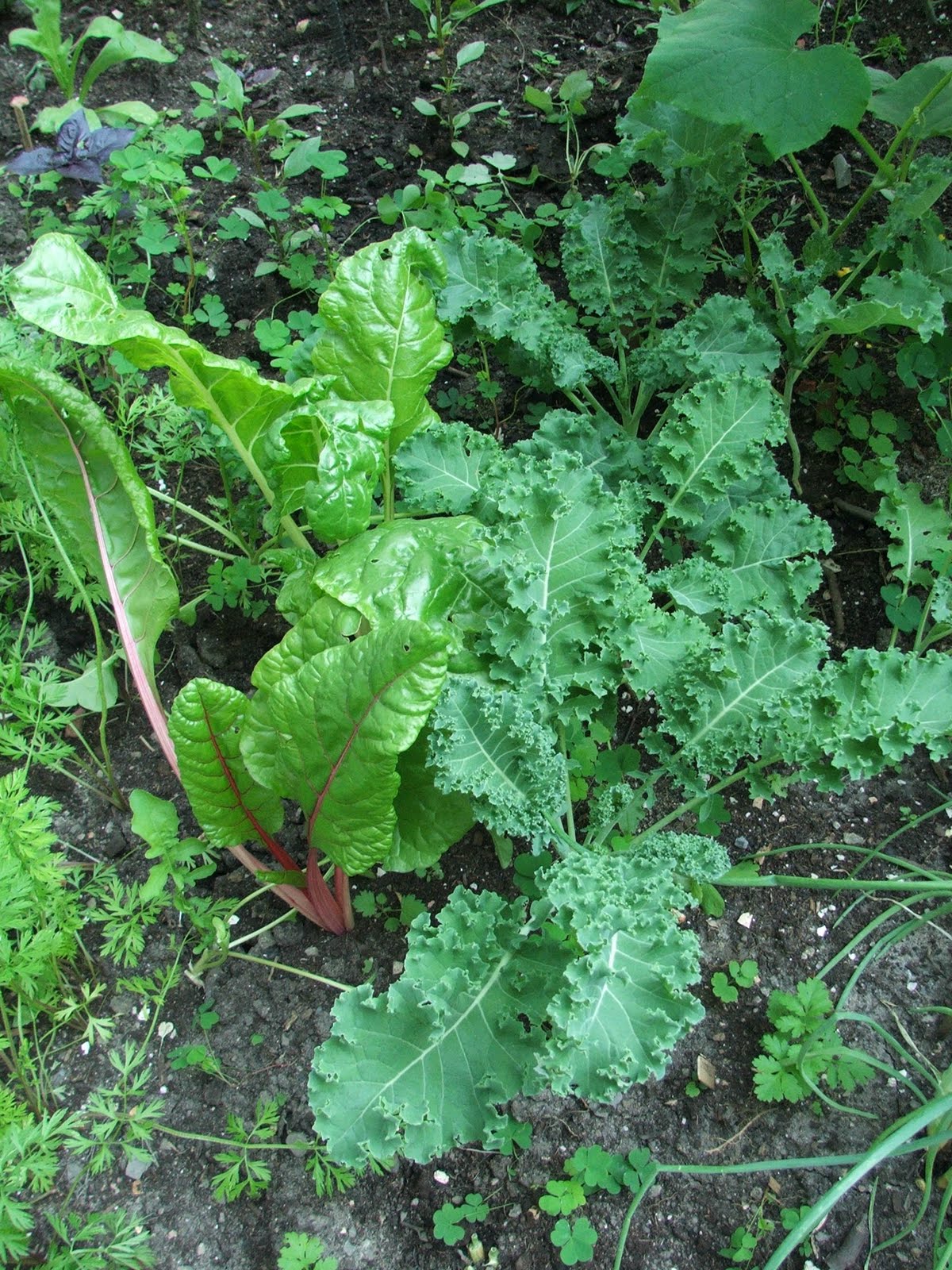 |
| Swiss chard and blue curled Scotch kale |
Kale - blue curled scotch
Lavender - English
Lavender - French
Lemon balm
Lettuce - red and 2 green varieties
Marigold
Mint - chocolate
Mint - pineapple
Mint - spearmint
Mustard greens
Onions - green multiplier
Pak choi - Tah tsai
Parsley - Moss
Parsley - Italian
Peas - snow
Pepper - carmen (sweet red)
Pepper, hot - Cayenne
Pepper, hot - Bulgarian carrot
Radish - Cherry belle
 |
| Hawaiian currant tomatoes are on their way!! |
Rosemary
Sage
Sunflower - giant
Sunflower - paquito
Swiss chard - Bright lights
Tomato - Hawaiian currant
Tomato - Matt's wild cherry
Tomato - Potato leaf
Tomato - Purple Russian
Yarrow
Zucchini - Contours Dorés
Subscribe to:
Posts (Atom)