 |
| Arugula leaf affected by leaf miners (upper leaf) and a healthy leaf (below). |
In the past couple of weeks we noticed the swiss chard hasn't been looking great. The leaves were greying and sections between the veins were limp. I initially thought the leaves might be getting sunburned, having recently be transplanted, so I tried to ignore it, thinking it would get better over time as the plants adjusted to life outside.
But it didn't get better. Yesterday I picked off a dying leaf and studied it carefully. To my horror I saw, between the layers of the leaf itself, a white maggot, leisurely chomping away at the tasty tissue of the chard. There were three or four of them in that leaf alone. I tossed the leaf to the ground and raced inside to look up "chard leaf miner" online. Sure enough,
many people are dealing with this problem and have written about it on their own blogs. Here's a quick summary of what I've learned about the leaf miner:
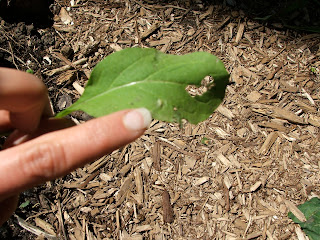 |
| The little white lump is the maggot inside the leaf. |
First off, there are hundreds of different species of leaf miners, all of them pretty specific to plant types or families. So the chard leaf miner will also be found on spinach and beet leaves, all members of the Chenopodiaceae family (sure enough they had got to some of my beet leaves!). They are the larvae of flies, moths, or butterflies that lay eggs on the undersides of leaves, often making a small cut in the surface of the leaf. When the eggs hatch the larvae crawl in and around the leaf feeding on its tissue. They can crawl down into the stem of the leaf or even the entire plant. It will go into a pupa stage in or on the leaf then fly away as an adult to mate. They can reproduce several generations over the course of the summer so they will cause an ongoing problem if not managed.
If you notice the signs immediately remove the affected leaves and put them in the trash or burn them. DO NOT PUT THEM IN YOUR COMPOST! They will propagate and perpetuate the problem! You can also look on the undersides of the leaves for the eggs: small, white ovals lying parallel to each other not more than 1mm long. If you spot the eggs simply brush them off. You should keep a close eye on the plants for the rest of the season. Several people recommend a weekly spraying of
neem oil as an organic treatment. It's pressed from the seed of the neem tree, so it's a natural product that poses no threat to the environment. It's also quite safe for humans, and apparently the plant has been used for medicinal purposes in India for thousands of years. Another suggestion is using row covers around the affected plants to keep the flies off. Row covers are a very fine mesh that let sun and water in but keep the bugs out. If these solutions don't work and the bugs become too much of a problem one site suggested pulling up the plants and waiting till September to grow them. The weather will be cooler which the plants tolerate well but which will kill the bugs.
~ ~ ~
Out in the garden today following up on the plants I noticed some of my arugula, kale, and even my mustard greens showed signs of leaf miners. Because these are members of the cabbage family (Brassicaceae, not the chard/ spinach family) I knew I had another species of leaf miner on my hands. Fortunately, the damage did not appear to be nearly as extensive as with the chard and I removed the few leaves that were affected. Hopefully there won't be a problem with them for the rest of the season, however, vigilance is required! My poor chard was stripped down to just the tiniest leaves at the center of the plants. Hopefully they will be able to make a comeback over the season.
For more reading, here's the link to a great
leaf miner identification site. It has information on hundreds of leaf miner species with an index listed by the affected plant names.


