If you're living anywhere near the Montreal region you must come by the Jardin Botanique de Montreal this weekend, February 9th-10th from 10am-4:30pm, for the 13th annual SEEDY WEEKEND. Organized by local urban ag. organization Action Communiterre, there will be 20 local seed-saving farmers selling organic and heirloom veggie, herb, and flower seeds, with a free community seed exchange at the end of the day. Plus there's a bunch of awesome FREE conferences about organic gardening and agriculture, food security, and what you can do to support new initiatives in Montreal and your community! It's so worth the trek and the selection and diversity of seeds is really amazing.
Cucumber Seedlings
Monday, February 4, 2013
It's never too early to be thinking about your garden
It may be -15°C in Montreal right now but there are at least a few reasons to be thankful for a cold winter: Cold weather kills bugs, bacteria, and other organisms that can be harmful to your harvest; a big pile up of snow means lots of water in the soil in spring that will help with seed germination and general soil fertility (not to mention some great opportunities to go sledding!); and the winter gives us a chance to rest from what can sometimes be back-breaking garden labor and give us a chance to plan our gardens for the upcoming season.
If you're like me and like to have as much control over what goes into your garden as possible, then mid-winter is one of the most exciting times of year. That's right, it's time to drool over seed catalogs at all the varieties of heirloom and organic seeds that could produce delicious, beautiful produce just for you. Or better yet, find out when and where the nearest seed sale and exchanges are happening and support your local organic farmers who are among the unsung heroes working to preserve our biodiversity and our traditions.
If you're living anywhere near the Montreal region you must come by the Jardin Botanique de Montreal this weekend, February 9th-10th from 10am-4:30pm, for the 13th annual SEEDY WEEKEND. Organized by local urban ag. organization Action Communiterre, there will be 20 local seed-saving farmers selling organic and heirloom veggie, herb, and flower seeds, with a free community seed exchange at the end of the day. Plus there's a bunch of awesome FREE conferences about organic gardening and agriculture, food security, and what you can do to support new initiatives in Montreal and your community! It's so worth the trek and the selection and diversity of seeds is really amazing.
Labels:
Action Communiterre,
Seedy Weekend
Thursday, September 13, 2012
Planting a Future - a documentary about urban agriculture in NDG, Montreal
Two Concordia film students approached Action Communiterre this spring, interested in urban agriculture in the borough of Notre-Dame-de-Grace (NDG), Montreal. For their course, they visited different organizations and gardens around the neighborhood to get a sense of the work being done and its impact in the community. There's even a short segment featuring the St. Monica School Garden!
Marche Locale - Concordia University's new local food market!
Congrats to my friend and colleague Amy Barrington on her successful organization of the Marche Locale at Concordia University. The market provides a space in the heart of downtown where local producers (and extremely local producers from around the city!) can sell their organic produce to students and passersby. The market can be found every Tuesday from 4:00-7:00pm at the Hall Building Terrasse on MacKay, near de Maisonneuve in Montreal.
Amy is a student at Concordia University and a Member of the Board at Action Communiterre.
Watch a CTV news clip on the market!!
For details and updates on the garden visit their website: http://marchelocalequartierconcordia.weebly.com/
Amy is a student at Concordia University and a Member of the Board at Action Communiterre.
Watch a CTV news clip on the market!!
For details and updates on the garden visit their website: http://marchelocalequartierconcordia.weebly.com/
Monday, April 16, 2012
Public Consultation: Urban Agriculture in Montreal - events schedule announced!
Great news!
The event schedule for Montreal's public consultation on urban agriculture has been released, along with a great new website! This follows a campaign of local NGOs and citizens to gather signatures in support of the consultation. Thanks to the City of Montreal's "Right to Initiative" the city is mandated to hold a public consultation on any issue when a certain minimum of citizens (15,000 I believe) support the initiative.
On November 15, 2011 citizens delivered a petition with nearly 29 000 signatures to the city and the public consultation was confirmed in December. After months of planning, the dates for the public consultation have been announced and will be held in May and June.
Citizens are also encouraged to submit their own urban agriculture activities to the website with a photo and description at: http://montrealacultiver.com/?page_id=54.
I have translated the event listing below from French into English, as the English listing does not seem to be available elsewhere:
This is the first information event where the public will have the opportunity to get to know the local actors involved in urban agriculture movement in Montreal.
1001, place Jean-Paul-Riopelle(downtown near Place d'Armes Metro)
This is the first information event where the public will have the opportunity to get to know the local actors involved in urban agriculture movement in Montreal. Registration is required, space is limited: ocpm.qc.ca/agricultureurbaine/colloque.
Final hearings for individuals and organization that wish to express themseleves on this issue: June 18, 7pm - 10pm: OCPM - 1550 rue Metcalfe, 14th Floor
For more information (in French) see: http://montrealacultiver.com/.http://montrealacultiver.com/.
The event schedule for Montreal's public consultation on urban agriculture has been released, along with a great new website! This follows a campaign of local NGOs and citizens to gather signatures in support of the consultation. Thanks to the City of Montreal's "Right to Initiative" the city is mandated to hold a public consultation on any issue when a certain minimum of citizens (15,000 I believe) support the initiative.
On November 15, 2011 citizens delivered a petition with nearly 29 000 signatures to the city and the public consultation was confirmed in December. After months of planning, the dates for the public consultation have been announced and will be held in May and June.
Citizens are also encouraged to submit their own urban agriculture activities to the website with a photo and description at: http://montrealacultiver.com/?page_id=54.
I have translated the event listing below from French into English, as the English listing does not seem to be available elsewhere:
Exposition: Saturday May 12, 2012 - 11:00am - 4:00pm
CCSE Maisonneuve Chapter- 4375 Ontario st. EastThis is the first information event where the public will have the opportunity to get to know the local actors involved in urban agriculture movement in Montreal.
Colloquium: Thursday May 17, 2012 - 9:00am - 5:00pm
Palais des congrès de Montreal Room 5191001, place Jean-Paul-Riopelle(downtown near Place d'Armes Metro)
This is the first information event where the public will have the opportunity to get to know the local actors involved in urban agriculture movement in Montreal. Registration is required, space is limited: ocpm.qc.ca/agricultureurbaine/colloque.
Public consultation sessions: in various neighbourhoods
- Ahuntsic-Cartierville: 7pm - 10pm - Saint-André Apôtre Church - 10505 rue de l'Esplanade
- Montreal-Central (i.e. Downtown, Plateau, Mile End, Villeray): 7pm - 10pm - Fraternité des policiers et policières de Montréal - 460, rue Gilford
- Montreal North: 7pm - 10pm - Centre récréatif Rivière-des-Prairies - 7650, boulevard Maurice-Duplessis
- Cote-de-Neige/Notre-Dame-de-Grace:7pm - 10pm - Centre Communautaire St-Raymond - 5600, rue Upper Lachine
Final hearings for individuals and organization that wish to express themseleves on this issue: June 18, 7pm - 10pm: OCPM - 1550 rue Metcalfe, 14th Floor
For more information (in French) see: http://montrealacultiver.com/.http://montrealacultiver.com/.
Thursday, April 12, 2012
Congratulations to Lauren!
Congratulations to Lauren who was recently selected as one of two inaugural PFF Community Leadership Fellows by McGill University.
After a very competitive selection process, Lauren received the good news that she was selected to have her project funded. Beginning this week, Lauren is working with Action Communiterre and the English-Montreal School Board for 8-months to build a brand new school and community vegetable garden at St. Monica Elementary School in the Notre-Dame de Grace (NDG) bourough of Montreal. She will actively engage the young daycare children and local youth in planting and maintaining the garden to grow all kinds of nutritious food for the community. She will be complementing the work in the garden with workshops for the kids on health, nutrition and the environment, as well as hosting community events centred around extremely local food!
For more information on the PFF Fellowship see: http://www.mcgill.ca/internships/pffprogram/2012-fellows.
The PFF Community Leadership Fellowships offer extraordinary opportunities to McGill students with innovative ideas, helping them to bring sustainable and positive social change to the communities in which they work.
After a very competitive selection process, Lauren received the good news that she was selected to have her project funded. Beginning this week, Lauren is working with Action Communiterre and the English-Montreal School Board for 8-months to build a brand new school and community vegetable garden at St. Monica Elementary School in the Notre-Dame de Grace (NDG) bourough of Montreal. She will actively engage the young daycare children and local youth in planting and maintaining the garden to grow all kinds of nutritious food for the community. She will be complementing the work in the garden with workshops for the kids on health, nutrition and the environment, as well as hosting community events centred around extremely local food!
For more information on the PFF Fellowship see: http://www.mcgill.ca/internships/pffprogram/2012-fellows.
Sunday, March 18, 2012
Spring has come early!
| Early spring is still a blend of browns and grays |
The tulips and crocus have pushed their leaves above the soil. I look forward to their blue and orange blooms in the coming months. But the arrival of the spring bulbs makes me curious about the garlic below the soil as well. I marked the garlic with thin green poles so I could anticipate its sprouting. The leaves I used to mulch and insulate the soil are still quite thick on the surface. But sure enough, as I peel them away I see the green garlic tips poking out from the warm soil. I'd like to also report that the chives are also making a nice showing and are already a few inches high. Ah, spring is in the air!
| Garlic and tulips and chives, oh my! |
Monday, March 12, 2012
"Environment A 'Vertical Greenhouse' Could Make a Swedish City Self-Sufficient"
This is pretty cool! I wonder if this is possible in all cities?
http://www.good.is/post/a-vertical-greenhouse-could-make-a-swedish-city-self-sufficient
Sunday, January 15, 2012
Plans for a New Year!
The remains of last season's stalks and plants have been chopped down and cover the soil. The garlic has been planted and lies dormant beneath the snow-covered soil. The winter offers a quiet break from work in the garden, but it won't be long before I flip through the seed catalogs and hang up the lamps to start my seedlings for the spring.
I'd call 2011 a pretty successful year. I finished off the season by attending a seed-saving workshop given through Santropol Roulant, and was able to practice my skills by saving seeds from some tomatoes (an heirloom Purple Russian that I grew, and some super sweet orange cherry tomatoes from our CSA basket), from some arugula that went to seed, and a bunch of flowers I found growing around the neighborhood (calendula, marigold, and other unknowns). I also did a big harvest of flowers and herbs for cooking and tea. I have a couple jars of sage, mint, and lemon balm, and some for rosemary and parsley as well. Mat has been making some delicious soups for us!
Looking forward to 2012, I have a few goals for the new season:
- Record the harvest! Small urban gardens are extremely productive, and it will be nice to know how much I'm producing and how much money I'm saving by growing my own organic produce.
- Expand the perennial herb/flower garden on the other side of the building. It's a shadier, tougher patch of earth to work, but planting a variety of perennial herbs and native plants will mean less work in the long term, and less watering and fertilizing, as these plants are adapted to the regional climate and soil. Flowering plants are also extremely important for attracting pollinators!
- More updates! While I prefer to be outside gardening more than being inside writing about gardening, writing is a fun opportunity to show some creativity, and let family and friends know what I'm up to.
Hope you all are staying warm this winter and happy 2012!!
| Drying flowers for tea: Mauve, Marshmallow, and red clover |
Looking forward to 2012, I have a few goals for the new season:
- Record the harvest! Small urban gardens are extremely productive, and it will be nice to know how much I'm producing and how much money I'm saving by growing my own organic produce.
- Expand the perennial herb/flower garden on the other side of the building. It's a shadier, tougher patch of earth to work, but planting a variety of perennial herbs and native plants will mean less work in the long term, and less watering and fertilizing, as these plants are adapted to the regional climate and soil. Flowering plants are also extremely important for attracting pollinators!
- More updates! While I prefer to be outside gardening more than being inside writing about gardening, writing is a fun opportunity to show some creativity, and let family and friends know what I'm up to.
Hope you all are staying warm this winter and happy 2012!!
Labels:
CSA,
seed saving
Monday, August 1, 2011
Eggplants, tomatoes, and beans, oh my!
Well, the end of July means a more exciting harvest. The basil is getting bushy, the first little tomatoes are starting to turn orange then red, there are even some cayenne peppers starting to peek out from underneath old blossoms. Yep, the hour of fruits is upon us! (Now, people tend to think of tomatoes, peppers, eggplants, and beans as vegetables. And sure, they are. But as far as plant anatomy goes, the part we're eating is the fruit of the plant, the part with the seeds in it.)
Now is the time where we get to make more interesting dishes with the harvest. Don't get me wrong, I love salads, but after 2 months of eating giant salads almost every day, I'm ready for a bit of a break. Yesterday I made pesto with fresh basil and parsley from the garden, as well as some from our organic family farmer. I modified a great recipe for 3-basil pesto from epicurious.com to include 5 types of basil in total. I have some great lemon basil plants whose seeds were a gift from friends. (Alyssa and Chris, it is as yummy as the name sounds!) I also added some purple basil and Thai basil for extra flavor dimensions. Blend together with Romano cheese, garlic, pine nuts, and a splash of olive oil and enjoy! Pesto apparently freezes really well, so take advantage of bushels that you may be growing yourself or that are selling at your local farmers' market and stock up for the winter!
Thursday, July 14, 2011
Cucurbit your enthusiasm
A vegetable garden is an amazing place for children to be in. There are so many different things to learn and talk about. I work in a collective garden as a children's coordinator with kids aged 2 to 8, and it's always interesting to see how they engage in the space. I like to give informal gardening lessons to some of the older kids. The cucurbit family (which includes cucumbers, melons, squash, and summer squash, like zucchini) is one of my favorite groups of plants to talk about.
Cucumbers and their relatives have two different types of flowers, male, and female, which makes for an interesting conversation about pollination (They "boy" flower has to kiss the "girl" flower, and the bees help them...). The first task is being able to tell the difference between male and female flowers. Male flowers always have a very slender stem. Female flowers have a thicker stem immediately below the base of the flower which resembles a miniature fruit. The male flowers always come out first and in more numbers than the fruit-bearing female flowers. The ratio of male to female flowers can also change on any given plant too. Usually if the plant suffers from water or nutrient stress it will put out mostly male flowers and few females. Bees play a critical role in all cucurbit fruit production. Unlike tomato flowers, which can be pollinated by the wind, cucurbit flowers must be
visited by bees between 15-20 times for successful fruit set. As the female flowers are often open for only a few hours on one day, timing is critical and it is very helpful to have a surplus of male pollen donors around. If the female flower is not adequately pollinated, the fruit will not set and you will see the stem turn yellow and drop off. If you're having problems with a lack of pollination, consider introducing bees to your garden or entice them by planting flowers. Bramble plants (raspberries, roses, and blackberries, etc) are an excellent bee attractor with their abundant pollen and sweet smells.
When the fruit does come, having too much ripening on the vine temporarily slows female flower output. Picking the fruit regularly (especially on cucumbers and summer squash) will encourage more fruit development.
Looking for cucumber beetles is another excellent activity. These yellow and black striped beetles like to eat the flowers, fruits, and roots, of all cucurbit family members, and may even spread bacterial wilt disease. They are often found on the flowers of cucurbits, which
provide an ideal mating "pad." When the beetles are found, pick them off the flower (they don't bite) and squish them immediately! It is important to check both open and closed flowers for the beetles as they may crawl inside and are not always immediately visible. After a couple minutes and several beetles, the kids in my garden have become expert beetle spotters and squishers, and are eager to find the next one.
| These two cucumber flowers are male. Note their very slender stems. |
| This cucumber flower is female; the stem looks like a mini cuke |
When the fruit does come, having too much ripening on the vine temporarily slows female flower output. Picking the fruit regularly (especially on cucumbers and summer squash) will encourage more fruit development.
Looking for cucumber beetles is another excellent activity. These yellow and black striped beetles like to eat the flowers, fruits, and roots, of all cucurbit family members, and may even spread bacterial wilt disease. They are often found on the flowers of cucurbits, which
| http://en.wikipedia.org/wiki/File:Cucumber_beetle.jpg |
Labels:
bees,
children,
collective garden,
cucumber,
cucumber beetle,
cucurbit,
flower,
pests,
pollination,
zucchini
Sunday, July 10, 2011
Greens go swimming and green onion upgrades
It's pretty amazing to come back from a two-week vacation and see how much everything has grown!! A huge thanks for my friends who stopped by to water and sample radishes. You did excellent work! But of course there is always much to do in the garden, so as soon as my suitcase was in the door I was out in the front doing some surveying. The tomatoes had to be tied up, the weeds needed a lesson in humility, one giant sunflower seemed to have given up on life, and of course, harvest!
Harvesting is the best work, reaping the bounty of the labour. I gathered a huge bag full of greens, most of which had bolted in my absence, so I had no choice but to pull the whole plant out. Lettuce, arugula, pak choi, radishes - most of each crop came out (I need to seed more!). My mustard greens had grown very big, but no signs of bolting so I just picked a few outer leaves from each plant to add some spiciness to the salad. I had a nice harvest of snow peas which we tossed into stir fry that evening. The swiss chard has made a fantastic recovery from the leaf miners (no neem oil was applied, but I did check daily for eggs and maggots before I left), and a few leaves can be harvested. My 'multiplier green onions' seemed to be living up to their name and had not only grown to almost two feet tall, but the bulbs were expanding away from each other at the surface of the earth. I cut off the greens just above the surface, then dug up and separated the bulbs and replanted them. I'm not sure if that's what I'm supposed to do, but we'll see if that experiment works. I had so many green onion trimmings I offered them to some neighbors in my building and across the street. One of them offered me a beer in exchange for the fresh shoots. Not a bad upgrade!
When harvesting greens, it's best to do it early in the morning before it gets too hot. This way the plants haven't started to transpire too much and won't wilt as fast. Later in the morning and throughout the day the leaves pump are pumping water (transpiring) through them from the roots and out through their pores (stomata). When the leaves are picked they continue to transpire but their water source has been severed so they become dehydrated and wilt. However, if you're like me, you won't be one of the first creatures moving about in the garden in the day and you'll find yourself harvesting in the heat. Not to worry. Simply bring a bucket of water with you into the garden and dunk the leaves in immediately after picking them. This will both supply them with water and cool them off so they reduce their transpiration. Ice water would be great but cool tap water works well too. Or you could just pick your produce and carry it into the kitchen when your done and soak them in the sink. That works too. However, it's best not to wait too long from the time of harvest till the leaves go swimming - you don't want the shriveling to go too far!
Harvesting is the best work, reaping the bounty of the labour. I gathered a huge bag full of greens, most of which had bolted in my absence, so I had no choice but to pull the whole plant out. Lettuce, arugula, pak choi, radishes - most of each crop came out (I need to seed more!). My mustard greens had grown very big, but no signs of bolting so I just picked a few outer leaves from each plant to add some spiciness to the salad. I had a nice harvest of snow peas which we tossed into stir fry that evening. The swiss chard has made a fantastic recovery from the leaf miners (no neem oil was applied, but I did check daily for eggs and maggots before I left), and a few leaves can be harvested. My 'multiplier green onions' seemed to be living up to their name and had not only grown to almost two feet tall, but the bulbs were expanding away from each other at the surface of the earth. I cut off the greens just above the surface, then dug up and separated the bulbs and replanted them. I'm not sure if that's what I'm supposed to do, but we'll see if that experiment works. I had so many green onion trimmings I offered them to some neighbors in my building and across the street. One of them offered me a beer in exchange for the fresh shoots. Not a bad upgrade!
| Greens go swimming |
Labels:
arugula,
green onion,
harvesting greens,
leaf miner,
lettuce,
mustard
Friday, July 1, 2011
So, what are you growing?
If you really want to know... here's what we're growing in the garden:
Arugula
Basil - Italian
| From the left: Purple basil, Italian basil, lemon basil |
Basil - Purple
Basil - Thai
Beans, bush - French filet
Beans, pole - Blue lake
Beans, pole - Yard long, climbing
Beets -Touchstone gold
Calendula
Carrot - Purple Dragon
Carrot - Berlicum 2
Chamomile
Chives
Cilantro
Cucumber - Marketmore
Cucumber - Pickling
Cucumber - sultan
Cucumber - thunder
Dill
Echinacea
Ground cherry
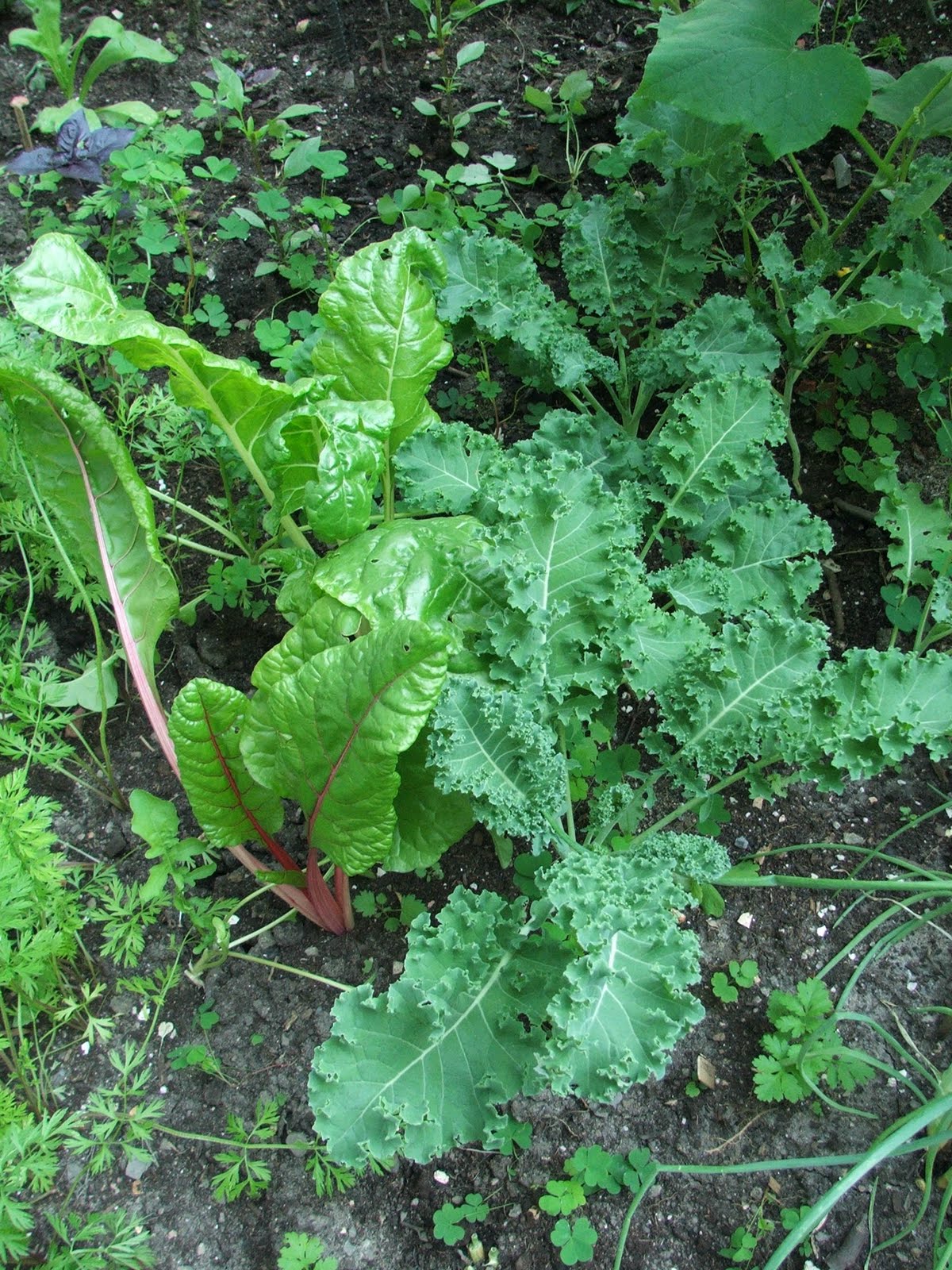
| Swiss chard and blue curled Scotch kale |
Kale - blue curled scotch
Lavender - English
Lavender - French
Lemon balm
Lettuce - red and 2 green varieties
Marigold
Mint - chocolate
Mint - pineapple
Mint - spearmint
Mustard greens
Onions - green multiplier
Pak choi - Tah tsai
Parsley - Moss
Parsley - Italian
Peas - snow
Pepper - carmen (sweet red)
Pepper, hot - Cayenne
Pepper, hot - Bulgarian carrot
Radish - Cherry belle
| Hawaiian currant tomatoes are on their way!! |
Rosemary
Sage
Sunflower - giant
Sunflower - paquito
Swiss chard - Bright lights
Tomato - Hawaiian currant
Tomato - Matt's wild cherry
Tomato - Potato leaf
Tomato - Purple Russian
Yarrow
Zucchini - Contours Dorés
Labels:
2011,
urban agriculture,
varieties
Wednesday, June 15, 2011
Lawns to Loaves
As a first post for me, Mat here, I admit that this a bit lazy. And those of you who know me, know I'm not exactly the biggest sports fan... but, as a Vancouverite away from home, I can't help but get wrapped up in Game 7 of the Stanley Cup. Watching it as I write in fact, and have Vancouver in my mind.
So for those of you who have a lawn and want to do something more useful than feed non-edible grass, this is for you.
A great new initiative from the Environmental Youth Alliance Society in Vancouver.
From the Vancouver Sun, June 15:
Make room for a wheat field beside the chicken coop
Read more: http://www.vancouversun.com/news/Make+room+wheat+field+beside+chicken+coop/4948581/story.html#ixzz1POYY5fQh
So for those of you who have a lawn and want to do something more useful than feed non-edible grass, this is for you.
A great new initiative from the Environmental Youth Alliance Society in Vancouver.
From the Vancouver Sun, June 15:
Make room for a wheat field beside the chicken coop
From chicken coops in backyards and vegetable plots at city hall, Vancouver is branching out into experimental wheat plots in place of lawns.The idea of replacing turf with a waving patch of yellow grain is among a list of ideas the Vision Vancouver-led council is considering for this year's Greenest City Neighbourhood grants allocations.
On Thursday, council will be asked to give a youth group, Environmental Youth Alliance Society, $5,000 for a pilot project called "Lawns to Loaves -A Collaborative City Wheat Field." The society has 30 homeowners willing to replace their lawns with small-scale grain production. It is also working with two eastside schools, Windermere and Vancouver Technical, to teach students about the origin and history of grain and where their bread comes from.
Read more: http://www.vancouversun.com/news/Make+room+wheat+field+beside+chicken+coop/4948581/story.html#ixzz1POYY5fQh
Tuesday, June 14, 2011
Leaf Miners Discovered!
| Arugula leaf affected by leaf miners (upper leaf) and a healthy leaf (below). |
But it didn't get better. Yesterday I picked off a dying leaf and studied it carefully. To my horror I saw, between the layers of the leaf itself, a white maggot, leisurely chomping away at the tasty tissue of the chard. There were three or four of them in that leaf alone. I tossed the leaf to the ground and raced inside to look up "chard leaf miner" online. Sure enough, many people are dealing with this problem and have written about it on their own blogs. Here's a quick summary of what I've learned about the leaf miner:
| The little white lump is the maggot inside the leaf. |
If you notice the signs immediately remove the affected leaves and put them in the trash or burn them. DO NOT PUT THEM IN YOUR COMPOST! They will propagate and perpetuate the problem! You can also look on the undersides of the leaves for the eggs: small, white ovals lying parallel to each other not more than 1mm long. If you spot the eggs simply brush them off. You should keep a close eye on the plants for the rest of the season. Several people recommend a weekly spraying of neem oil as an organic treatment. It's pressed from the seed of the neem tree, so it's a natural product that poses no threat to the environment. It's also quite safe for humans, and apparently the plant has been used for medicinal purposes in India for thousands of years. Another suggestion is using row covers around the affected plants to keep the flies off. Row covers are a very fine mesh that let sun and water in but keep the bugs out. If these solutions don't work and the bugs become too much of a problem one site suggested pulling up the plants and waiting till September to grow them. The weather will be cooler which the plants tolerate well but which will kill the bugs.
~ ~ ~
Out in the garden today following up on the plants I noticed some of my arugula, kale, and even my mustard greens showed signs of leaf miners. Because these are members of the cabbage family (Brassicaceae, not the chard/ spinach family) I knew I had another species of leaf miner on my hands. Fortunately, the damage did not appear to be nearly as extensive as with the chard and I removed the few leaves that were affected. Hopefully there won't be a problem with them for the rest of the season, however, vigilance is required! My poor chard was stripped down to just the tiniest leaves at the center of the plants. Hopefully they will be able to make a comeback over the season.
For more reading, here's the link to a great leaf miner identification site. It has information on hundreds of leaf miner species with an index listed by the affected plant names.
Labels:
beet,
cabbage,
chard,
leaf miner,
pests
Tuesday, June 7, 2011
Planning Your Garden - Basics to keep in mind
It's amazing how many plants can be grown in such a small space! Neighbors and friends ask me what I'm growing and I feel like I should give them an abridged version to keep them interested. In fact, in a little more than 220 square feet I'm growing over 50 different varieties of plants and there's still room for my neighbors to park their bicycles. Some plants are growing directly in the ground, in raised beds I have dug out, and some are in containers. The key a successful garden is knowing a bit about the plants, how they grow, and what their needs are. Here are some things to consider when planning your garden:
Sunlight
Most grains and fruit-bearing plants, like eggplants, peppers, beans, etc, need at least 6 hours of direct sunlight for proper production so they should be put in the sunniest parts of your garden. In shadier parts, it's better to stick more with leafy crops like lettuce, chard, arugula, and some herbs like mint. Spinach and Kale do better in full sun.
Water
All life needs water. It's where the chemistry of life happens. But like everything, different plants have their different preferences as to amounts and conditions of their water. Most plants don't like to sit in pools of water, and prefer well-draining soils. However, some plants have higher preferences than others. Strawberries and raspberries both like sandier, very well-drained soils. Their roots will rot if the soil is too wet. Tomatoes and cucumbers need a fairly steady supply of water, so their soils can be less sandy and hold water better. Zucchinis are very thirsty plants, but having water on their leaves makes them susceptible to mildew that can cripple and kill the plant. It's better to water only the soil of the zuke, an try to avoid the leaves.
Compost
Yes. Compost is important. I just needed to get that out there. Compost and manure do a lot of great things for your soil. Here are three of them: First, it adds organic matter, or decomposed plants and animals, which helps hold nutrients better in your soil. Second, it contributes to a healthy microbiology in your soil. There are lots of important bacteria, bugs and worms, and fungi that live in the dirt that do things like aerate the soil, add nutrients, and even fight off invading diseases. Organic matter is the food for the soil's life. Without the microbes, you will have unhappy plants. Third, compost provides a slow release of nutrients to the soil, especially micro-nutrients. It can also help balance the pH of the soil, but that's getting technical. When adding compost to your soil, add a good inch or two on top then mix it in as thoroughly as you can, ideally in the top foot of soil. It will encourage your plants roots to go deep into the soil. In a container you can have up to 25% of the potting mix be compost.
Topography
Look at the space of your garden creatively! Don't be constricted by the soil alone. If you have a fence or a railing on one side, try planting some climbing beans or cucumbers to crawl up it. If you have tree stumps or concrete in your way use a self-watering container to put around it or on top of it. Have a gutter nearby? Why not have it empty into a large trash can and use the rain water for your plants when it gets sunny again. Rain water is preferable to tap water because tap water is treated with chlorine. It will kill the germs in your water, but it's also hard on your soil's microorganisms too.
Spacing
Tomato plants need between 1.5 and 2 feet between plants to be happy, and cucumbers like 12 inches between plants. Radishes need about 2 inches, and beets take 4. Each plant is different so it is important to have a reference to check if you're unsure.
Companion Planting
Some plants grow better together than when grown apart. Some plants grow worse together than when grown apart. Knowing these time-tested pairings of companion planting can add to your garden's success. Lettuce grows well planted next to carrots and radishes. Planting basil around your tomatoes will improve the growth and flavor of both. Planting marigolds around your garden will work to repel all sorts of mean insects. Different herbs repel specific insects, and help specific plants grow. It's worth taking a look at a list of companion planting to know which combinations to try and which to avoid.
Food
While plants make their own food, they need to get the raw materials somewhere, and some plants need more than others. The main building block is carbon, which they get from the air (CO2). Next they need nitrogen (N), phosphorus (P), and potassium (K). These three macro-nutrients are what all fertilizers are concerned with. You've probably seen N-P-K or even 3 numbers (like 8-4-5 or 20-20-20 something) written on the side of a bag or container. That's what this is about. Nitrogen is essential for vegetative or leafy growth; phosphorous is important for root development; potassium is used for flower and fruit production, and is also linked to fighting diseases. Tomatoes, peppers, eggplants, cucumbers, zucchinis, and squash, are considered heavy feeders and need the most N-P-K of all your vegetables. Yellowing leaves are a sign of nitrogen deficiencies. Especially if you're growing any of these in containers, I'd recommend fertilizing them at least once a month.
There are also important micro-nutrients which include calcium, iron, boron, copper, zinc, magnesium, manganese, and molybdenum. Plants use a lot less of these nutrients than the macro nutrients, but they are still very important. Deficiencies in calcium, for example, cause spots of rot on the ends of fruits. Synthetic, chemical fertilizers tend to have higher concentrations of N-P-K than organic or biologically based fertilizers, but don't have any micro-nutrients in them. They must be added separately. Additionally, most chemical fertilizers are made from petroleum, and take huge amounts of energy to produce. Although organic fertilizers have lower concentrations of the macro-nutrients, they still provide the the N-P-K to plants and are also a well-rounded source of micro-nutrients as well. Some great organic fertilizers are fish emulsion, blue-green algae, and chicken manure.
For more detailed information on starting a garden I recommend reading "How to Grow More Vegetables" by John Jeavons. It's got tons of great information on preparing your vegetable bed, plant spacing, expected yields, making compost, companion planting, the works! It's thorough and easy to read, a great reference for any level of gardener.
Sunlight
Most grains and fruit-bearing plants, like eggplants, peppers, beans, etc, need at least 6 hours of direct sunlight for proper production so they should be put in the sunniest parts of your garden. In shadier parts, it's better to stick more with leafy crops like lettuce, chard, arugula, and some herbs like mint. Spinach and Kale do better in full sun.
Water
All life needs water. It's where the chemistry of life happens. But like everything, different plants have their different preferences as to amounts and conditions of their water. Most plants don't like to sit in pools of water, and prefer well-draining soils. However, some plants have higher preferences than others. Strawberries and raspberries both like sandier, very well-drained soils. Their roots will rot if the soil is too wet. Tomatoes and cucumbers need a fairly steady supply of water, so their soils can be less sandy and hold water better. Zucchinis are very thirsty plants, but having water on their leaves makes them susceptible to mildew that can cripple and kill the plant. It's better to water only the soil of the zuke, an try to avoid the leaves.
Compost
Yes. Compost is important. I just needed to get that out there. Compost and manure do a lot of great things for your soil. Here are three of them: First, it adds organic matter, or decomposed plants and animals, which helps hold nutrients better in your soil. Second, it contributes to a healthy microbiology in your soil. There are lots of important bacteria, bugs and worms, and fungi that live in the dirt that do things like aerate the soil, add nutrients, and even fight off invading diseases. Organic matter is the food for the soil's life. Without the microbes, you will have unhappy plants. Third, compost provides a slow release of nutrients to the soil, especially micro-nutrients. It can also help balance the pH of the soil, but that's getting technical. When adding compost to your soil, add a good inch or two on top then mix it in as thoroughly as you can, ideally in the top foot of soil. It will encourage your plants roots to go deep into the soil. In a container you can have up to 25% of the potting mix be compost.
Topography
| Pole beans (bottom left) will be trained to climb up the railing. |
Spacing
Tomato plants need between 1.5 and 2 feet between plants to be happy, and cucumbers like 12 inches between plants. Radishes need about 2 inches, and beets take 4. Each plant is different so it is important to have a reference to check if you're unsure.
Companion Planting
Some plants grow better together than when grown apart. Some plants grow worse together than when grown apart. Knowing these time-tested pairings of companion planting can add to your garden's success. Lettuce grows well planted next to carrots and radishes. Planting basil around your tomatoes will improve the growth and flavor of both. Planting marigolds around your garden will work to repel all sorts of mean insects. Different herbs repel specific insects, and help specific plants grow. It's worth taking a look at a list of companion planting to know which combinations to try and which to avoid.
Food
While plants make their own food, they need to get the raw materials somewhere, and some plants need more than others. The main building block is carbon, which they get from the air (CO2). Next they need nitrogen (N), phosphorus (P), and potassium (K). These three macro-nutrients are what all fertilizers are concerned with. You've probably seen N-P-K or even 3 numbers (like 8-4-5 or 20-20-20 something) written on the side of a bag or container. That's what this is about. Nitrogen is essential for vegetative or leafy growth; phosphorous is important for root development; potassium is used for flower and fruit production, and is also linked to fighting diseases. Tomatoes, peppers, eggplants, cucumbers, zucchinis, and squash, are considered heavy feeders and need the most N-P-K of all your vegetables. Yellowing leaves are a sign of nitrogen deficiencies. Especially if you're growing any of these in containers, I'd recommend fertilizing them at least once a month.
There are also important micro-nutrients which include calcium, iron, boron, copper, zinc, magnesium, manganese, and molybdenum. Plants use a lot less of these nutrients than the macro nutrients, but they are still very important. Deficiencies in calcium, for example, cause spots of rot on the ends of fruits. Synthetic, chemical fertilizers tend to have higher concentrations of N-P-K than organic or biologically based fertilizers, but don't have any micro-nutrients in them. They must be added separately. Additionally, most chemical fertilizers are made from petroleum, and take huge amounts of energy to produce. Although organic fertilizers have lower concentrations of the macro-nutrients, they still provide the the N-P-K to plants and are also a well-rounded source of micro-nutrients as well. Some great organic fertilizers are fish emulsion, blue-green algae, and chicken manure.
For more detailed information on starting a garden I recommend reading "How to Grow More Vegetables" by John Jeavons. It's got tons of great information on preparing your vegetable bed, plant spacing, expected yields, making compost, companion planting, the works! It's thorough and easy to read, a great reference for any level of gardener.
Labels:
garden design,
self-watering container
If at first you don't succeed
Last summer, construction on the outside of our apartment building rerouted my plans for a garden from the front of our building to its roof top. My first solo gardening project, indeed my first gardening activity since the third grade, was suddenly more experimental than I had anticipated. I bought a collection of plastic storage containers and large pots, filled them with rocks, dirt, and compost, stuck in my seedlings and crossed my fingers. Like a novice monk, I spent the summer carrying buckets of water, filled in our bathtub, up three flights of stairs to the roof where I poured them over my parched plants. I managed to get a decent harvest of cucumbers, some great zucchini, several harvests of herbs, and even a few tomatoes and peppers. It was very modest, but encouraging. By the way, I forgot to tell my landlord, who knew of my desire to plant in the front, that I had moved my operations to the roof.
We came home one afternoon after labour day weekend and the smell of basil was in the air outside of our apartment. Looking at the ground out front, we suddenly saw all of my containers. Most of them were broken, the earth and the plants they had held were raked out across the ground, shards of bright blue plastic half-buried among them. With tears streaming down my face I stepped among the wreckage of my garden, trying to salvage some basil and chive plants that had been buried whole. It was a tragic day.
Mat called the landlord who explained that he had just discovered my containers over the weekend. Having recently redone the roof of the building he was more than a little concerned about potential damage their weight might cause. Being too heavy to carry down, he decided to launch them off the side of the building instead. Well! We would have at least liked to see the fall!
It was agreed by both our landlord and ourselves that the entire situation could have been handled better by both parties, and our landlord reimbursed us for half the cost of the materials that had been broken. He promised that next year I would have dictatorial gardening powers over the front and would even put new soil down.
So here we are in the spring of 2011 and I am very excited to have our new garden in the front. With the help of some friends I have spent hours loosening up the soil and adding compost. I started seedlings inside and they have recently been transplanted. But the first plants to come up in April, before I had begun to do any work at all, were those rescued chives, three bright green patches. They are perennials, I suddenly learned, and had survived a particularly cold Montreal winter. Now here they were, a pungent sign of encouragement for the new season.
We came home one afternoon after labour day weekend and the smell of basil was in the air outside of our apartment. Looking at the ground out front, we suddenly saw all of my containers. Most of them were broken, the earth and the plants they had held were raked out across the ground, shards of bright blue plastic half-buried among them. With tears streaming down my face I stepped among the wreckage of my garden, trying to salvage some basil and chive plants that had been buried whole. It was a tragic day.
Mat called the landlord who explained that he had just discovered my containers over the weekend. Having recently redone the roof of the building he was more than a little concerned about potential damage their weight might cause. Being too heavy to carry down, he decided to launch them off the side of the building instead. Well! We would have at least liked to see the fall!
It was agreed by both our landlord and ourselves that the entire situation could have been handled better by both parties, and our landlord reimbursed us for half the cost of the materials that had been broken. He promised that next year I would have dictatorial gardening powers over the front and would even put new soil down.
So here we are in the spring of 2011 and I am very excited to have our new garden in the front. With the help of some friends I have spent hours loosening up the soil and adding compost. I started seedlings inside and they have recently been transplanted. But the first plants to come up in April, before I had begun to do any work at all, were those rescued chives, three bright green patches. They are perennials, I suddenly learned, and had survived a particularly cold Montreal winter. Now here they were, a pungent sign of encouragement for the new season.
Labels:
roof top garden
Thursday, June 2, 2011
"Urban agriculture" - just a fancy name for gardening?
It's true that saying "urban agriculture" does seem to add a little more legitimacy to my career path than simply saying, "um, vegetable gardens?" But for me the term holds more meaning than just the noble work of vegetable cultivation. Urban agriculture is also about questioning a way of life that is increasingly disconnected from the natural cycles of our planet. It is a practical response to many of the fundamental challenges facing humanity today: how will we feed our planet's growing population; how will we reduce our pollution and waste so we can become true stewards (and not parasites) of the planet; how can we become more self-sufficient in societies that are increasingly dominated by corporations; how can we as citizens become more engaged in our communities to bring about positive change?
As I'm sure many of you already know, these problems are interconnected and there is no "magic bullet" solution. But there are valuable lessons to be learned and lots of ground to be gained by returning to the roots, plant roots that is, and reconnecting mama nature with her children of the city. I hope you enjoy following our blog as we delve into the depths of urban agriculture and try to become better citizens of our city and our planet.
Labels:
urban agriculture
Subscribe to:
Posts (Atom)